
Type “corner couch” into a British furniture site and you’ll scroll past a wall of L shaped sofas. Type “sectional” into an American one and you’ll find, more or less, the same wall. So what exactly are you choosing between?
Honestly, not much. The label barely matters. What matters is whether the shape can change later, whether the pieces will clear your front door, and whether the corner you’re building around is really going to stay put.
This guide clears up the terminology in about thirty seconds, then spends the rest of its time on the stuff that actually decides whether a corner couch or a sectional works in your living room. For a closer look at one side of the debate, our guide to choosing the right corner couch for your living room picks up where this one leaves off.
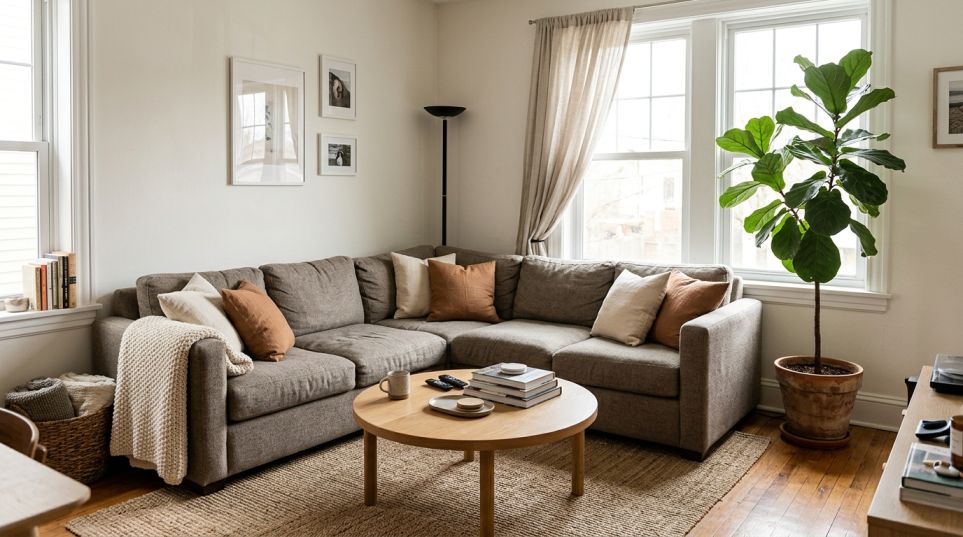
Corner Couch vs Sectional Sofa Is There Really a Difference?
Mostly it’s a vocabulary gap. “Sectional” is the everyday North American word for a multi piece sofa that wraps a corner, while “corner sofa” is the British and European term for essentially the same thing, and retailers swap the two freely. A corner couch, strictly speaking, is a sectional built as a true 90 degree L, which is how one buying guide frames it.
Where the words do split, at least in U.S. showrooms, is flexibility.
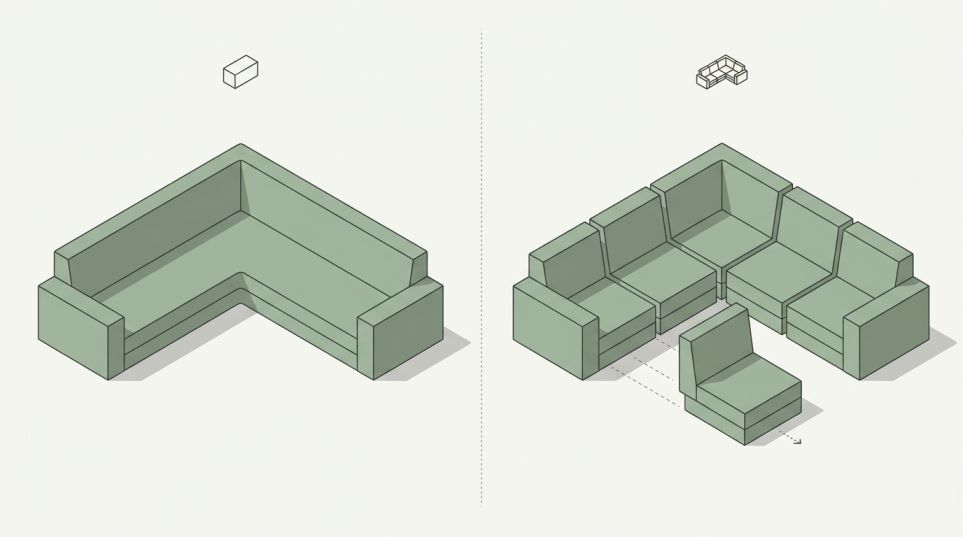
- Fixed corner couch: one set shape. You order an L, you keep an L.
- Modular sectional: separate seat, corner, arm, and chaise pieces that connect together and can be rebuilt into new layouts later.
Set a modular sofa up as an L and it works exactly like a corner couch. The difference only shows up afterward, when you want to change something.
Fixed vs. Modular at a Glance
| Fixed corner couch | Modular sectional | |
|---|---|---|
| Shape | Set at purchase | Can become an L, a straight sofa, or separate pieces |
| Price | Usually lower for similar seating | Often higher up front |
| Moving day | Bulky, harder on stairs | Smaller, lighter units |
| Damage | Repair the frame or replace the sofa | Often possible to replace one section |
| Stability | One solid frame | Pieces can shift if connectors are weak |
| Best for | A permanent corner and a firm budget | Renters, growing households, changing rooms |
Those trade offs line up with comparisons from Interior Insider and Povison, though prices swing widely by brand, so compare specific models before you decide.
When a Corner Couch Is the Smarter Buy
A fixed L earns its keep when the corner is permanent and the room has to pull double duty. Picture a compact living room where the corner currently holds a floor lamp and nothing else, and the same space has to handle movie night, overnight guests, and someone working from the couch. That’s exactly the room buying guides point to for a corner couch.
It’s also the gentler option on your budget. If you know your space and want maximum comfort for less money, a traditional sectional usually delivers, and there are no connectors to loosen over time.
Size is manageable, too. Apartment-size sectionals run about 78 to 94 inches, while a standard one sits closer to 95 to 110 inches wide, according to Seatcraft.
The catch: if you rearrange furniture every few months, a fixed L will fight you every time.
When a Sectional Sofa Wins
Lean modular if any of these sound familiar:
- You rent. Next year’s floor plan is a mystery, and modular pieces can adapt to it.
- Your stairs or hallway are tight. A full size traditional sofa can weigh 150 pounds or more in one chunk, while a modular set splits that into smaller, lighter units.
- You live with kids or pets. Replacing one damaged section beats replacing the whole sofa.
- Your living room shares space with a kitchen or dining area. Which brings us to the best trick in the sectional playbook.
Let the Sofa Do the Work of a Wall
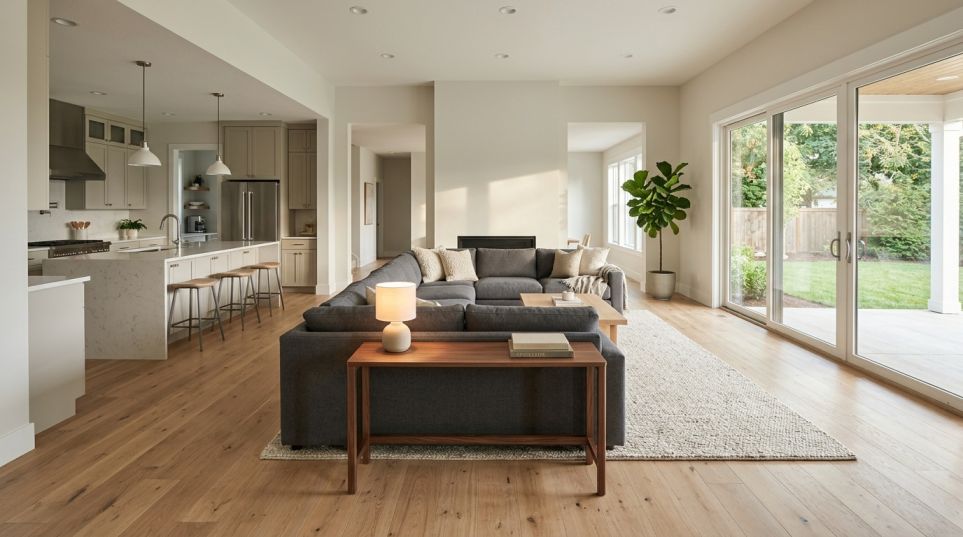
In an open floor plan, a sectional can mark where the living area ends without building anything. Placing one to separate the living zone from the kitchen or dining area is a common layout move. Two details make it work.
First, give the back a finish. If people see it from the kitchen, treat it like a wall, with a slim console and a lamp. Second, anchor the whole thing with a rug. One furniture brand calls a rug essential in a floating setup because it ties the sofa and coffee table into a single zone. And plan on 30 to 40 inches of clearance around a floating sectional.
Measure Before You Fall in Love
Here’s where most corner couch purchases quietly go sideways. Not the style. The math.
The Numbers Worth Knowing
| What to check | Typical range | Why it matters |
|---|---|---|
| Overall sectional length | 94 to 156 inches | Sets the wall space you need |
| Chaise or return | 60 to 72 inches | Eats floor space fast |
| Seat depth | Standard 21 to 28 in.; deep 28 to 35 in. | Upright sitting vs. lounging |
| Main walkway clearance | 30 to 36 inches | Below 30 and the sofa is too big |
The first three ranges come from Wayfair’s sectional measuring guide, and the 36 inch walkway figure shows up in Cozey’s size guide too. A handy sanity check: a sofa tends to look right at about two thirds the length of the wall it sits against.
Run the Tape Test
Costco’s measuring guide suggests outlining the sofa on the floor with masking tape. Do it, then leave the tape down for a few days. Carry a laundry basket from the kitchen to where the couch would sit. Open the dishwasher. If you’re turning sideways anywhere, the couch is too big.
Measure the inside of the L, too. That’s the space your coffee table has to live in, and it’s smaller than most people expect. Aim for about 14 to 18 inches between sofa and table.

Check the Path In
Measure every doorway, hallway, and stairwell between the truck and your living room, then compare them against the largest piece, diagonal depth included. In a building with an elevator, measure both the door and the inside of the cab. And ask the retailer for the packaged dimensions, not just the finished ones.
Left Facing or Right Facing? Don’t Guess
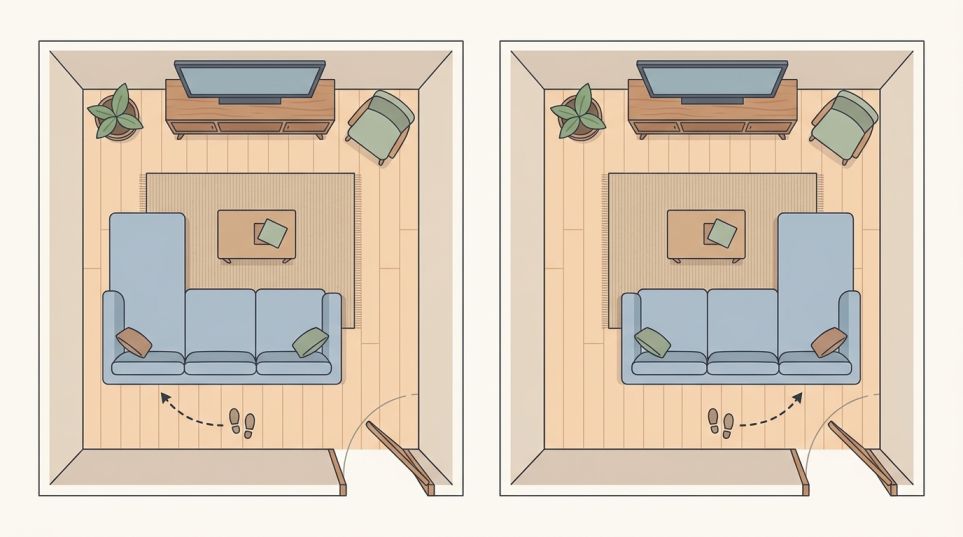
Stand in front of the sofa and look at it. If the long arm or chaise stretches to your left, it’s a left-facing piece. To your right, it’s right facing, per Povison’s corner sofa guide. Listings shorten these to LAF and RAF, so check the definition on the product page before you order. A wrong-handed sofa is an easy mistake to make and a hassle to return.
The placement rule worth remembering the long side should extend away from your main walking path, never across it. The same guide also flags pushing the corner toward the doorway as a common mistake.
What’s Inside Matters More Than the Label
Fixed or modular, a sofa lives or dies by its frame. Kiln dried hardwood such as oak, maple, or ash resists warping, while particleboard or softwood frames tend to loosen or sag within a few years. Most sofas last somewhere between 7 and 15 years, according to Interior Insider. There’s no official standard, and the American Home Furnishings Alliance’s Patricia Bowling says it depends on construction and use.
Two questions to ask before you buy:
- What’s the frame made of, and how are the corners reinforced? The corner is where two sections meet, and reinforced corners with proper joinery help a frame last.
- For modular sets, how do the pieces lock together? Shifting pieces and a higher price are the most common complaints.
In a showroom, sit down, shift your weight, and listen. A frame that creaks or flexes is telling you something.
Which One Should You Buy? A Quick Checklist
Go with a fixed corner couch if:
- The corner is permanent for the next several years
- You’d rather spend less up front
- You want a single solid frame with no connectors
- Your layout is simple: two walls, one sofa, done
Go with a modular sectional if:
- You rent or might move soon
- Stairs, hallways, or an elevator make delivery tricky
- You want to float the sofa or split up an open plan
- You’d like to add or replace sections down the road
Key Takeaways
- “Corner couch” and “sectional” are mostly regional names. Fixed versus modular is the real decision.
- Measure the room, the inside of the L, and every door, hallway, and stairwell on the way in.
- Keep 30 to 36 inches clear for walkways, and tape the footprint on the floor first.
- Check the left or right orientation and ask about the frame before you order.
Conclusion
The corner couch versus sectional debate sounds bigger than it is. Underneath the labels, you’re choosing between a shape that stays and a shape that can change. Your corner, your doorway, and your next move will usually answer that for you.
Tape it out, measure the path, and ask about the frame. Do those three things and the name on the tag hardly matters.
Still sorting out the rest of the room? Browse more living room decor ideas for layout and styling inspiration, or explore everything at Vibe Nest Studio. And if you’re stuck between the two, tell us your room size and what you’re leaning toward in the comments.